
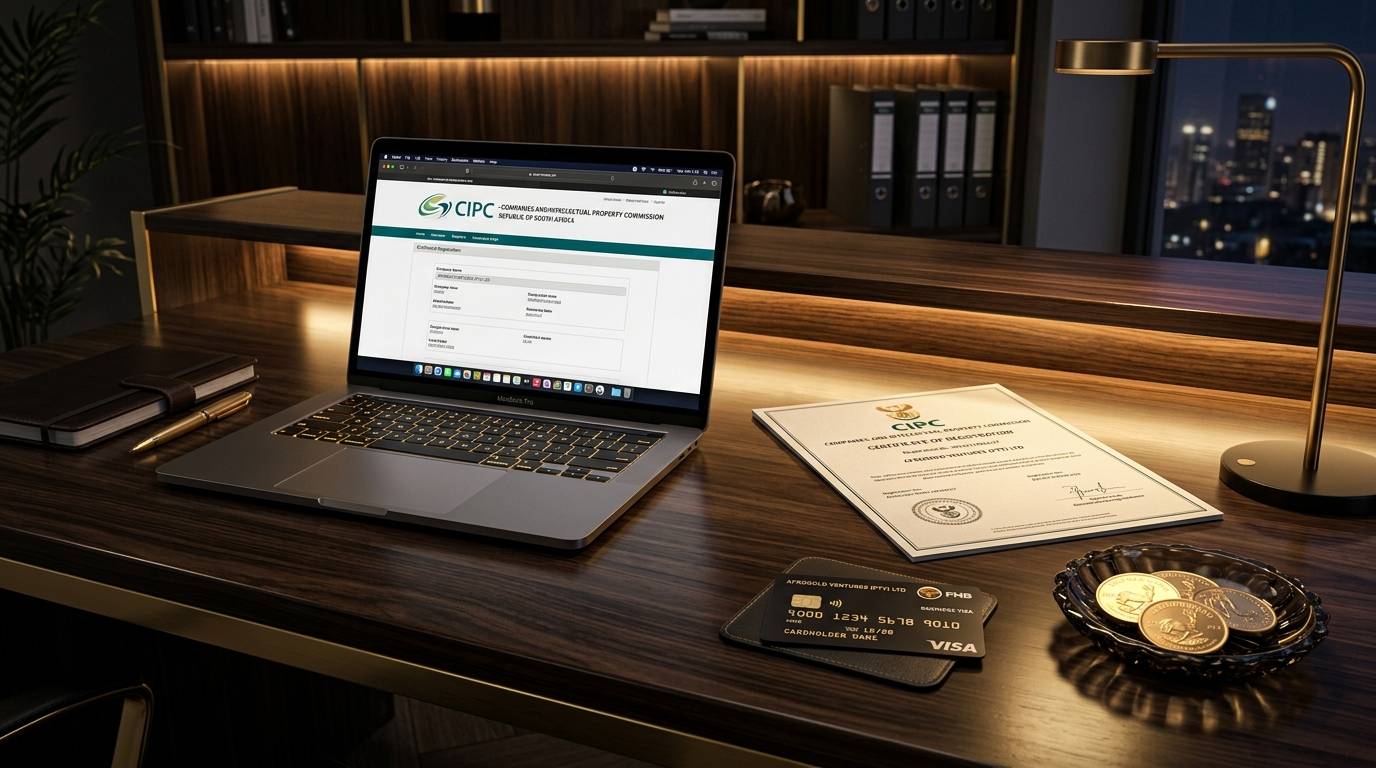
Starting a new business in South Africa is an incredibly exciting journey, but it can also feel like navigating a bureaucratic minefield.
As a new entrepreneur, you are suddenly hit with a dozen questions: How do I register with CIPC? What is a tax clearance certificate? Do I need a business bank account? How do I get a domain and a website without blowing my entire startup capital?
💡 Budget Launch Strategy
Worse yet, many service providers preying on new startups will charge you astronomical fees (upwards of R10,000) just to get your basic legal paperwork and website set up. You don't need to overspend.
This step-by-step 2026 startup blueprint shows you exactly how to start a small business in South Africa, get your company legally compliant, and launch professionally online for under R3,500 total.
Step 1: Legal Registration with CIPC (Cost: R175)
Do not pay a consultant R1,500 to register your company. You can do it yourself directly through the CIPC (Companies and Intellectual Property Commission) portal:
- Register on BizPortal: BizPortal (bizportal.gov.za) is a brilliant, official South African government website designed for small business setup.
- Submit Company Name Reservation: Submit up to 4 potential names. This costs R50.
- Register Your Private Company (Pty) Ltd: Once the name is approved, complete the company registration. This costs R125.
- Tax Number: The CIPC will automatically generate your official SARS Income Tax number for free upon successful registration.
Step 2: Open a Zero-Fee Business Bank Account (Cost: R0)
Under South African law, you should never run business transactions through your personal bank account. This makes bookkeeping a nightmare and risks tax compliance issues. Fortunately, digital bank choices require no monthly fee:
- TymeBank Business: R0 monthly fee, free EFTs, and easy cash deposits at Boxer or Pick n Pay.
- FNB First Business: A solid entry-level business account with a R0 monthly fee and access to FNB's digital ecosystem.
- Lulalend / Lula: Specifically built for SA startups, offering modern cash flow dashboards and quick access to credit.
Step 3: Get Your SARS Tax Compliance (Cost: R0)
To pitch for corporate clients or submit government tenders, you must have a Tax Clearance Certificate (TCS):
- Log into SARS eFiling using the tax number generated during your CIPC registration.
- Request your "Tax Compliance Status."
- As long as your filings are up to date, SARS will issue a real-time Tax Compliance PIN for free, which you can share with potential clients.
Step 4: Establish Your Digital Footprint (Domain & Web Engine)
With paperwork complete, your next priority is building brand trust. In South Africa, customers verify unknown startups by searching Google. Follow these steps:
1. Register a .co.za Domain Name
Your domain is your digital address (e.g., yourbusiness.co.za). This costs R150 to R300 per year. Read our South African Website Cost Guide for more details.
2. Launch a High-Speed Single-Page Website
Choose a modular single-page website model. This lets you look highly professional while protecting cash flow. Follow our Small Business Website Blueprint for features you actually need.
3. Set Up Direct WhatsApp & Local SEO
South Africans prefer instant messaging. Read our WhatsApp Integration Guide and Local Lead Strategy to start converting visitors into leads immediately.
Step 5: Your First Month in Business (A Practical Checklist)
What should you actually do in the first 30 days after CIPC approves your registration? In short: sort your bank account, your tax status, and your website, in that order, so you can focus on finding clients instead of chasing paperwork.
Work through this list and the admin stays quiet while you hunt for customers:
- Week 1: Open your business bank account (see Step 2 above) and move any payments into it. Start a simple cashbook, even a spreadsheet, and log every expense from day one.
- Week 2: Log into SARS eFiling, confirm your tax number, and check your Tax Compliance Status. When you hire your first employee you must also register for PAYE, UIF, SDL, and COIDA.
- Week 3: Register your domain and get the website live. A clean one-pager beats no site at all when a client Googles you. See our Small Business Website Blueprint for the features you actually need.
- Week 4: Claim your Google Business Profile (it is free) and add your WhatsApp number, working hours, and service area so local searches find you. Follow our WhatsApp Integration Guide for the setup.
One date worth saving: your CIPC annual return is due every year on the anniversary of your registration. Filing late attracts penalties, so set the reminder now.
One-Page Website vs 5-Page Website: Which Should a New Business Choose?
Should a new business start with a one-page website or a five-page site? Start with a single page when you offer one core service and need to win local clients fast, then expand to separate pages once you have several services or a portfolio worth showing.
Every page costs money to build and time to keep updated. Here is the comparison:
| Comparison | One-page site | 5-page site |
|---|---|---|
| Best for | Sole traders and local services with one main offer | Businesses with several services or a portfolio |
| Build cost | R1,499 once-off (Allegro base package) | Higher, depending on pages and features |
| Launch speed | Live within days | Live within a few weeks |
| Ongoing cost | R800/mo hosting and support | R800/mo and up as pages grow |
| Search visibility | Ranks well for one or two local keywords | More pages, more keywords you can target |
| When to expand | When a second service needs its own page | For a blog or portfolio as content grows |
Most startup owners we work with launch the one-pager first, then grow into more pages as revenue allows.
What Does Running a Website Really Cost Beyond the Build Fee?
How much does a business website cost in South Africa beyond the build fee? Plan for three recurring costs: the domain at R150 to R300 a year, hosting and support at R800 a month on a managed plan, and small extras like email and accounting tools.
The once-off build fee gets the attention, but the monthly numbers are what keep owners up at night:
- Domain: R150 to R300 per year for a .co.za address, renewed annually. Make sure it is registered in your name, not your designer's. Our South African Website Cost Guide has the full picture.
- Hosting and support: R800 per month on the managed plan we recommend: hosting, security updates, backups, and someone to call when something breaks.
- Email: A mailbox on your own domain looks more professional than a Gmail address. Free mail forwarding covers the basics; paid mailboxes cost a small monthly fee per account. [SOURCE NEEDED]
- Accounting: QuickBooks Online and Xero run monthly subscriptions that start modest and scale with turnover. Until your invoices outgrow a spreadsheet, the spreadsheet is fine.
- POPIA compliance: If your site collects enquiries, you handle personal information. POPIA, in force since 1 July 2021, requires a privacy policy on your site and, for most businesses, a named Information Officer. Your web designer can include it in the build.
Add it up: a domain, managed hosting, and a professional site still land under the R3,500 total quoted at the top of this guide. The mistake is paying for extras you do not need yet.
Where to Find Free and Low-Cost Business Help in South Africa
Where can a new South African business get free help? Start with SEDA for free training and mentoring, SEFA for small business funding, and the NYDA if you are under 35, then add free tools like Google Business Profile and WhatsApp Business.
In South Africa you do not have to pay for the basics:
- SEDA (Small Enterprise Development Agency) offers free training, mentoring, and incubation support in every province. Book a session with your nearest branch early.
- SEFA (Small Enterprise Finance Agency) provides funding for small and emerging businesses that struggle to get bank loans. Applications take time, so start before you need the money.
- NYDA (National Youth Development Agency) runs training and funding programmes for entrepreneurs aged 18 to 35.
- Government portals: BizPortal and SARS eFiling, both covered earlier in this guide, are free to use. Your provincial economic development department can point you to local SMME programmes.
- Free digital tools: Google Business Profile, WhatsApp Business, and Canva's free tier cover the basics while your budget grows.
Your cheapest resource is your network. Past employers, suppliers, and fellow owners have already solved the problem you are facing today. Ask them for referrals and honest feedback; most will give it freely.
The Allegro Digital "Startup Starter Kit"
We are passionate about helping South African startups launch and scale sustainably. We understand that every Rand matters when you are building your runway. Check out our Startup packages and pricing options.
- • Custom Logo Design: R1,500 once-off (2-3 custom vector concepts).
- • Base Web Design & Launch: R1,499 once-off (custom-coded, ultra-fast single-page site).
- • Mandatory High-Speed Hosting & Support: R800/month.