
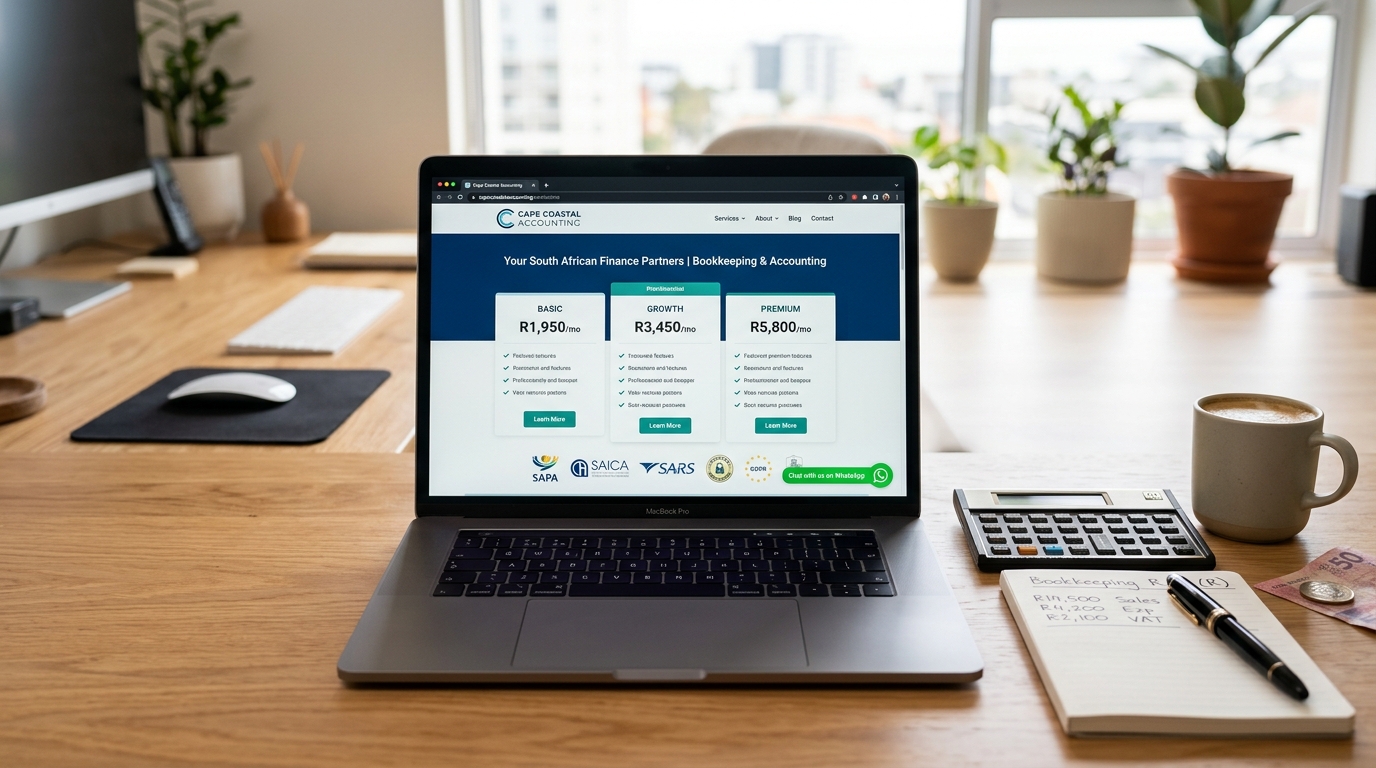
Type "bookkeeper port elizabeth" into Google and watch what it finishes for you: "how does a bookkeeper charge", "how much do bookkeepers charge", "how much should a bookkeeper charge". That is not a coincidence. It is what real clients in South Africa type before they phone anyone. The person asking that question is your ideal client, and right now, most solo bookkeepers have no website for them to land on. Bookkeeper website design in South Africa is really the design of trust: a site that answers the price question before the call.
Here is the uncomfortable part. If you run a solo bookkeeping practice and a potential client searches "how much do bookkeepers charge", they will not find you. They will find articles written by accounting software companies, forum threads, and a handful of bigger firms. Your name will not come up, because you have no online presence to come up in. The client never learns you exist, and the work goes to someone who bothered to be findable.
The search data says the gap is wide open
Two verified facts from August 2026 make this worth acting on now.
First, local clients search in price terms. "bookkeeper port elizabeth" autocompletes to the charge questions above. Even the newer term "bookkeeper gqeberha" shows the same early-mover pattern: barely anyone is using it yet, which means whoever claims it now owns it while it grows.
Second, the supply side is empty. Search "bookkeeper website design south africa" and you will not find a single South African agency page aimed at bookkeepers. The results are Upwork, international firms, and a Western Cape accountant's page that happens to mention bookkeeping. No SA agency is writing to you, and none is competing for that search. It is a genuine gap, and it will not stay open forever.
The trust problem is bigger than the visibility problem
A bookkeeper handles money. Before a small business owner hands over their invoices, their payroll, their SARS submissions, they need to trust you. That trust used to form over the phone and through referrals. Now it forms online, before you ever speak.
Here is what the client does: they get your name from a friend, or they search "bookkeeper near me", and then they check. Does this person have a real practice? Are they registered? What do they charge? Do other people vouch for them? If that check turns up a Facebook page from 2019, or nothing at all, the referral starts to feel risky. Not because you are bad at your job. Because the client cannot verify you.
A website is the cheapest trust infrastructure a solo bookkeeper can buy. It does not need to be fancy. It needs to answer the questions that make a stranger trust you with their numbers.
What a solo bookkeeper's website actually needs
Keep it to five pages, and keep each page boring and honest:
A home page that says what you do and who you serve. "Monthly bookkeeping and VAT for small businesses in Port Elizabeth." One or two lines. Your phone number and WhatsApp button visible without scrolling.
A services page that names the work. Monthly bookkeeping, VAT returns, payroll, SARS submissions, tax clearance. One service per section, plain language, no jargon. The client should be able to read it and know which one they need.
A price page, or at least a "from R..." figure. This is the one most bookkeepers skip, and it is the one that answers the client's actual search. You do not have to publish a full rate card. A starting monthly rate for a small business, stated plainly, answers "how much do bookkeepers charge" before the client has to ask. If you price per transaction, say that, and give a realistic range for a typical client.
A page that proves you are legitimate. Your SAIPA, SAIT or SARS registration number, how long you have been practising, who you actually are. For a solo practice this page matters more than any other. It is the digital version of the certificate on your wall.
A contact page with WhatsApp and a POPIA-compliant form. South African small business owners follow up on WhatsApp, not email forms. A WhatsApp button that lands in your phone, answered within a working day, wins the enquiry every time. And because you handle financial data, a short privacy statement matters. POPIA compliance is a trust signal, not admin.
The price question you will face either way
Two price conversations happen in this niche, and they are different.
One is what bookkeepers charge their clients. That is your business, and you should own it on your site, because the client is searching for it before they call.
The other is what a bookkeeper's own website costs. Here is the honest market picture: the only SA firm that publishes a bookkeeping-specific price is Whale Coast Web, at R15,000 to R35,000 for a website taking four to six weeks. That is their published range, current as of June 2026, and it is at the premium end. A working five-page site in this market runs from around R1,499 once-off plus a monthly care cost with a small local agency, which is well within reach of a practice that bills monthly retainers. There are options in between. The point is not to overspend; the point is to have something that answers the trust check.
| Bookkeeper website options | No website | Premium agency | Local agency care |
|---|---|---|---|
| Once-off build | R0, but invisible | R15,000–R35,000 (Whale Coast Web's published range, June 2026) | From R1,499 |
| Monthly care | — | Usually quoted separately | From R800, all in |
| Build time | — | 4–6 weeks | 2–4 weeks |
| Answers "how much do bookkeepers charge" | No | Only if the content does | Yes, on your price page |
| Fits a solo practice | Never | Rarely | Yes |
💡 The page most bookkeepers skip
The price page. You do not need a full rate card, just a starting monthly rate for a small business, stated plainly. It answers "how much do bookkeepers charge" before the client has to ask, and it is the page that turns a referral into a call.
The honest timeline
A solo bookkeeper website is a small project. A good five-page site realistically takes two to four weeks with an agency, less if you have your copy ready. The free parts, a claimed Google Business Profile and a few genuine client reviews, can happen this week and start working immediately. We walk through the profile setup in how to get your SA business on Google Maps.
If you are already getting referrals, a website does not replace them. It does something better: it makes every referral cheaper to keep. When someone recommends you, the first thing the client does is look you up. A clean, honest site confirms the recommendation. No site quietly undermines it.
The clients are out there typing "how much do bookkeepers charge" into Google right now. The solo bookkeepers who answer that question on their own websites are the ones who will get the call. The same trust logic runs through the accountant website cost guide, and the budget side of the ledger is covered in our South African website cost guide.
Get Your Bookkeeping Practice Found Online
We build fast, WhatsApp-first trust sites for solo bookkeepers across South Africa, with transparent R1,499 setup plus R800/mo hosting and support. Let's get the price question answered before the call.